Installing solar panels is one of the smartest energy decisions a Lebanese homeowner can make. After years of load shedding, expensive diesel generators, and unpredictable grid supply, solar has become less of a luxury and more of a necessity. But for many owners, the project stops once the panels are mounted and the inverter is humming along. The system works, the bills go down a little, and that feels like the end of the story.
It isn’t. Solar panels generate electricity, but they don’t decide how that electricity is used. That decision still falls on the homeowner, often made manually, out of habit, and without much visibility into what’s actually happening behind the meter. This is where a smart home solar system changes the equation. By connecting solar production, battery storage, and household consumption through automation, a smart home turns a good solar installation into a genuinely efficient one.
Solar Without Smart Control Is Only Half the Solution
A solar system produces energy on its own schedule, not yours. Panels generate the most power between roughly 10 a.m. and 3 p.m., when the sun is highest. But household energy consumption in Lebanon tends to peak in the evening, when families are home, air conditioners are running, and water heaters kick in after a long day.
This mismatch between production and consumption is the single biggest reason solar owners don’t get the full value out of their systems. Batteries help close the gap, but they have limits. Most residential battery banks are sized for a few hours of backup, not a full day of demand shifting. Once the battery is depleted, the home falls back on the grid or a generator, both of which come at a real cost in Lebanon.
Home automation solves a problem that hardware alone cannot: timing. Automated systems can sense when solar production is high and battery charge is healthy, then decide, in real time, how to route that energy. Without this layer of intelligence, even a well-designed solar setup ends up relying more on stored or grid energy than it should. Solar energy management is not an added feature; it’s what makes the rest of the investment work as intended.
Shift Energy Consumption to Solar Production Hours
Load scheduling is one of the most practical benefits of pairing solar with home automation. The idea is simple: instead of running high-consumption appliances whenever it’s convenient, a smart system runs them when solar production is at its peak.
A few examples make this concrete:
- Water heaters can be scheduled to heat water during midday sun rather than in the evening, when the house is drawing on battery or grid power.
- Air conditioners can pre-cool rooms during peak solar hours, reducing the need to run compressors later when demand from the rest of the home is higher.
- Washing machines and dishwashers can be set to start automatically once solar output crosses a certain threshold, rather than running at night out of habit.
- Pool pumps, which often run for hours at a stretch, are ideal candidates for solar-hour scheduling since their timing is flexible and their consumption is significant.
- EV chargers, for households that have them, can be configured to charge only when there is surplus solar power, turning excess daytime production into stored transportation energy instead of wasted capacity.
None of this requires homeowners to change their daily routines. The scheduling happens in the background, guided by rules set once and adjusted as needed. The result is a home that consumes electricity when it’s cheapest and cleanest to produce, rather than when it happens to be convenient.
Monitor Your Home’s Energy in Real Time
Most homeowners can tell you their monthly electricity bill. Very few can tell you which appliance is responsible for most of it. Smart energy monitoring closes that gap.
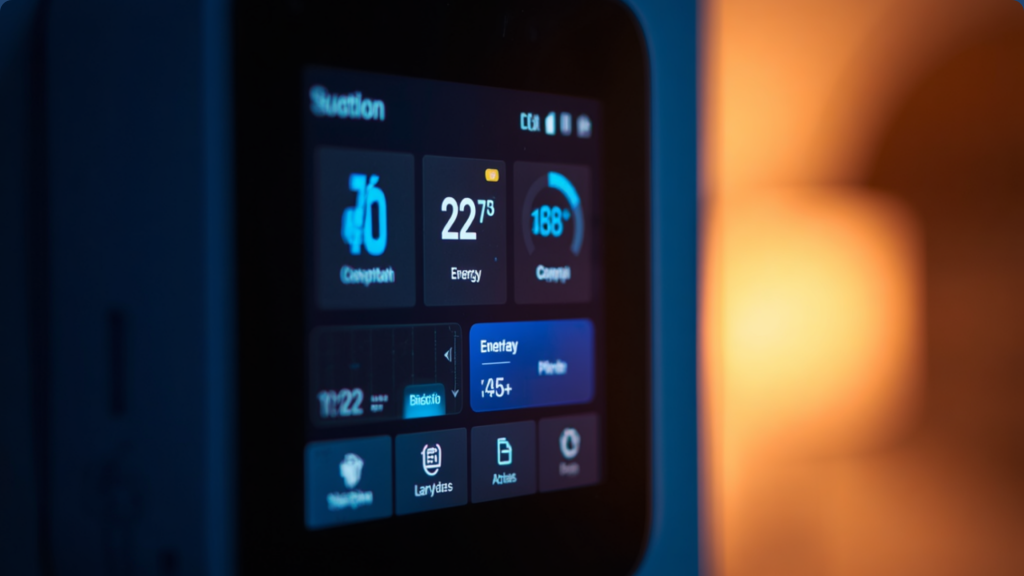
Smart plugs attached to individual appliances, combined with whole-home monitoring at the panel level, give a device-by-device breakdown of consumption. Smart meters track usage patterns over days and weeks, not just a single monthly total. Mobile applications put all of this in the homeowner’s pocket, with dashboards that show solar production, battery state, and grid draw side by side.
The practical value of this visibility is often underestimated. When people can see, in real numbers, that a water heater or an old air conditioning unit is consuming far more than expected, they change their behavior almost immediately. Energy waste that used to be invisible, a phantom load left running overnight, a pump cycling more than it needs to, becomes obvious and easy to correct. Monitoring doesn’t just report on energy use. It actively shapes better decisions.
Protect Your Solar Investment
A solar array, inverter, and battery bank represent a significant investment, often the largest single purchase a homeowner makes for their property after the house itself. Protecting that investment deserves the same attention as maximizing its output.
Smart breakers and monitoring devices add a layer of protection that traditional electrical panels don’t offer. They can detect overloads before they trip a circuit, flag unusual power draw that might indicate a failing appliance or wiring issue, and send overload alerts directly to a homeowner’s phone rather than waiting for something to fail outright.
Battery protection is particularly important in the Lebanese context, where inconsistent grid supply can lead to irregular charge and discharge cycles if left unmanaged. Fault detection and preventive monitoring help catch problems, such as a malfunctioning charge controller or a battery cell behaving abnormally, before they become expensive repairs. For equipment that took years of saving to install, this kind of oversight isn’t an add-on. It’s basic risk management.
Increase Battery Life
Batteries are the most expensive component to replace in a solar system, and how they’re used day to day has a direct impact on how long they last. Smart energy management extends battery life in a few specific ways.
First, it avoids unnecessary discharge by prioritizing solar energy for immediate use whenever it’s available, rather than pulling from the battery out of habit or poor coordination between components. Second, it optimizes charging cycles, avoiding the deep discharges and rapid recharges that degrade battery chemistry over time. Third, by prioritizing solar and battery power intelligently, it reduces how often a backup generator needs to switch on, cutting fuel costs and running hours on equipment that has its own maintenance demands.
Solar battery optimization isn’t about squeezing out a marginal improvement. Over several years, the difference between a well-managed battery and a poorly managed one can mean an entirely different replacement timeline, and a meaningfully different total cost of ownership.
Improve Comfort While Saving Energy
Efficiency and comfort are often treated as trade-offs, but a properly configured smart home delivers both. Automatic lighting adjusts to occupancy and natural light levels, so rooms aren’t lit when no one is in them. Smart thermostats learn household patterns and adjust temperature settings accordingly, reducing energy use without anyone having to think about it. Motion sensors extend this logic throughout the home, coordinating lighting, climate, and even security based on actual activity rather than fixed schedules.
Remote control means homeowners can check in on their property from anywhere, adjusting settings or confirming everything is running as expected. Vacation mode reduces a home’s energy footprint automatically when no one is present, avoiding the waste of a fully powered but empty house. Energy scenes allow multiple settings, lighting, climate, and specific appliances, to shift together with a single command, matching the home’s behavior to how it’s actually being used at any given moment.
Why This Matters in Lebanon
The case for smart home automation is stronger in Lebanon than in most markets, for reasons rooted entirely in the local energy landscape. Frequent power cuts mean households already juggle multiple power sources: grid, generator, and solar. Coordinating between them manually is inefficient and, frankly, exhausting. Automation removes the guesswork.
Generator dependence remains high across the country, and every kilowatt-hour shifted from generator fuel to solar and battery power is a direct saving. With electricity costs continuing to rise, the margin for waste has shrunk. A home that captures and uses solar energy efficiently isn’t just more comfortable to live in; it’s measurably cheaper to run, month after month. In a market where every kilowatt produced carries real financial weight, maximizing its use isn’t optional. It’s the difference between a solar system that pays for itself on schedule and one that takes years longer to break even.
Why Choose WeVolt
WeVolt works with homeowners across Lebanon to bring these pieces together: smart home automation, solar monitoring, energy management, and intelligent electrical systems, integrated into a single, coherent setup rather than a patchwork of separate gadgets.
The approach centers on a few clear outcomes: reducing monthly electricity costs, maximizing the value of solar energy that’s already being produced, improving day-to-day comfort, and protecting the electrical and battery equipment that represents a serious household investment. Homeowners who explore WeVolt’s Smart Home Solutions or Solar Energy Management services typically start with a straightforward question: their solar system is running, so why isn’t it saving as much as expected? That question is usually the entry point to a broader conversation about automation, monitoring, and long-term protection.
Conclusion
Solar panels are the foundation of energy independence, but they aren’t the whole structure. A smart home is what turns that foundation into a system that actively works in the homeowner’s favor, shifting consumption to match production, revealing waste that would otherwise go unnoticed, and protecting an investment that took real money and planning to build.
If you already own a solar system in Lebanon, the next step isn’t necessarily more panels. It’s smarter control over the ones you have. Contact Us to speak with the WeVolt team about a personalized consultation and see what a fully connected, automated home could look like for your household.